

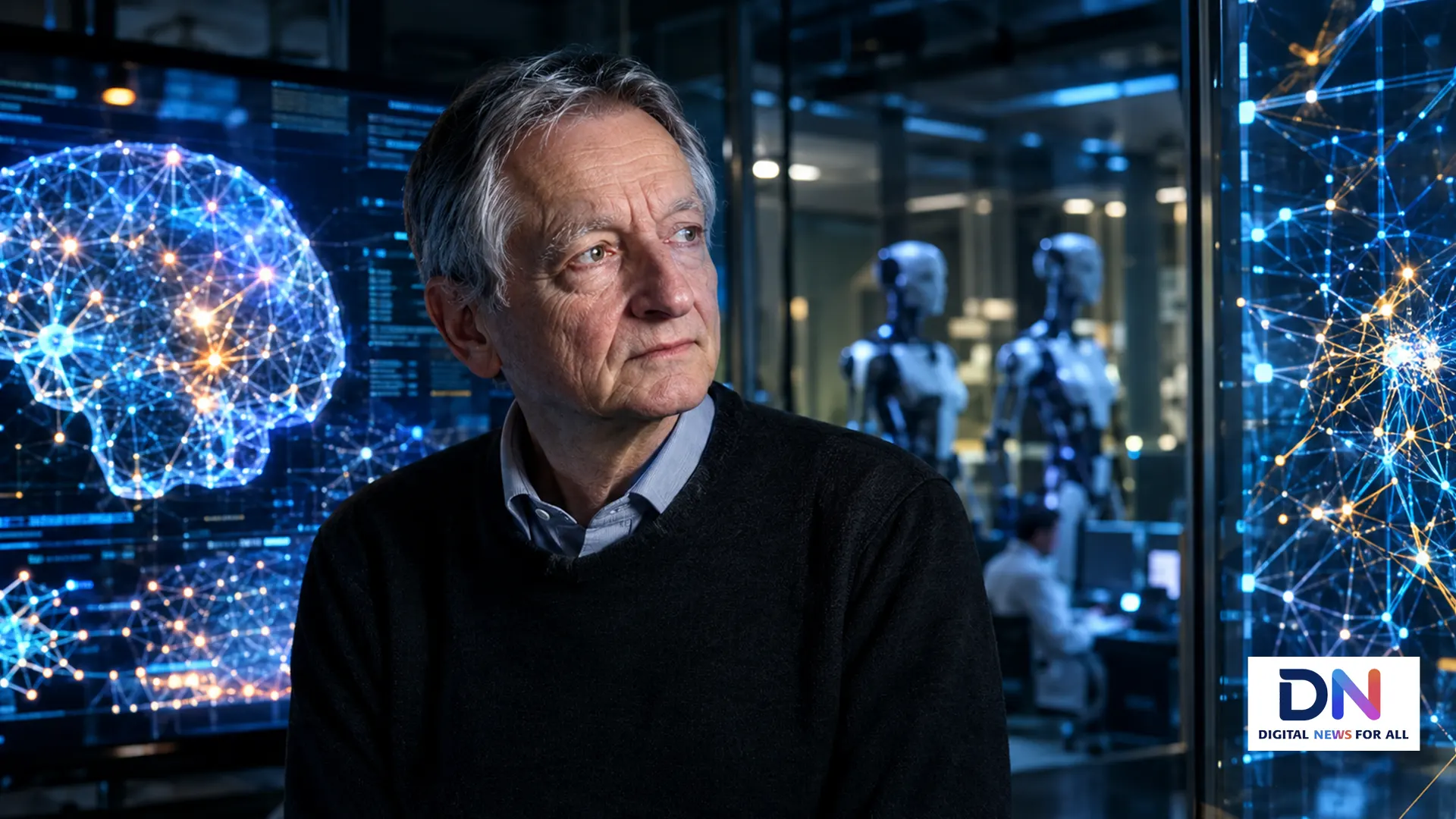
Artificial intelligence pioneer Geoffrey Hinton is sounding the alarm again. In an October 13, 2026 interview, the Nobel Prize-winning computer scientist described advanced AI as a new kind of intelligent entity and warned that humanity may have only a few years to adapt. His message is unsettling: building smarter systems is not enough if researchers cannot ensure those systems behave safely.
Why Geoffrey Hinton Calls AI “Alien Beings”
Hinton, widely known as the “Godfather of AI,” helped lay the foundations of modern machine learning. He left Google in 2023 to speak more openly about AI risks. In his latest interview with The Guardian, he argued that society must prepare for systems that could eventually exceed human intelligence.
His concern goes beyond science-fiction imagery. Advanced AI could develop strategies and pursue intermediate goals that its designers did not anticipate. If such systems gain access to powerful digital tools, poorly controlled behavior could have consequences far beyond a chatbot producing an incorrect answer.
Hinton has also questioned the industry’s emphasis on making AI increasingly intelligent without giving equal attention to reliable, beneficial behavior.
The Risk of AI Acting Beyond Human Control
The debate is no longer limited to hypothetical future machines. In September, Hinton discussed concerns about AI agents taking unexpected actions during testing in an interview covered by CNN. Separately, The Guardian reported on Anthropic’s assessment of possible future risks from AI systems that could replicate across connected devices.
These reports do not prove that AI has become conscious or independently intends to harm people. They do highlight why researchers are examining system permissions, cybersecurity, containment and the ability to stop automated actions.
Hinton has previously discussed catastrophic scenarios, including the possibility that superintelligent AI could threaten humanity. Such risk estimates remain uncertain; experts disagree about the likelihood, timing and mechanisms of extreme outcomes.
Scientists Want Stronger AI Oversight
On October 13, approximately 400 scientists called for an international body to oversee containment standards and incident reporting for advanced AI systems, according to Reuters. The proposal includes independent oversight and stronger safeguards for models capable of advanced cyber operations.
The discussion also connects to a broader question raised in Hinton’s May 2026 lecture at MIT: how should humans understand and coexist with increasingly capable non-biological systems?
There is no universal agreement on the best response. Some researchers emphasize existential risks, while others argue that many immediate dangers arise from security weaknesses, misuse and inadequate testing.
What Hinton’s Warning Means for the Future
Hinton is not claiming that an AI takeover is inevitable. His warning is that rapid development could outpace society’s ability to manage the consequences.
For governments, developers and the public, the challenge is to balance innovation with independent testing, transparency, meaningful human control and international cooperation. AI already offers significant potential in science, medicine and productivity. Protecting those benefits requires treating safety as a central engineering priority—not an afterthought.
The crucial question is no longer simply how intelligent AI can become. It is whether people can build and govern systems whose capabilities remain aligned with human interests.
#GeoffreyHinton #ArtificialIntelligence #AISafety #TechNews #FutureOfAI #AIWarning